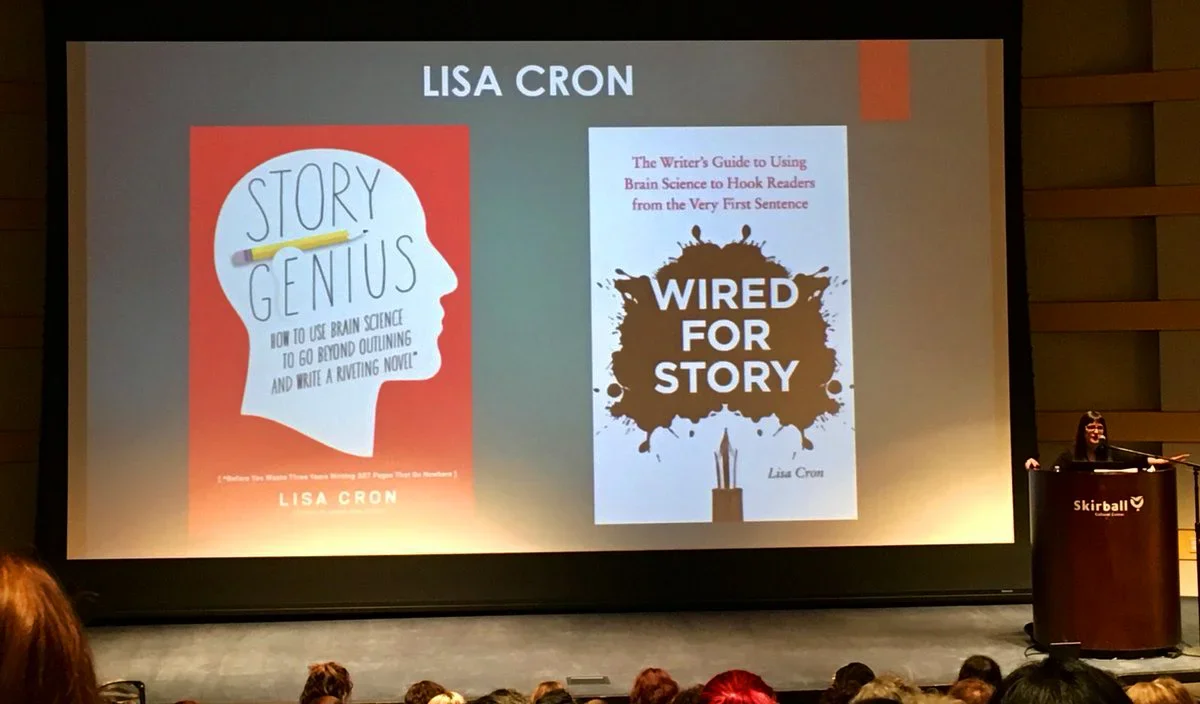
There is nothing I love more than talking story with a roomful of writers.
I speak at writing conferences, schools and universities across the country.
Keynote Address
Wired for Story: What Your Reader's Brain Really Craves, and How To Deliver It
Imagine knowing what we’re hardwired to crave in every story we encounter, what hooks readers from pre-school to 80, and what keeps them turning pages. The answer is a game-changer, especially since the secret to writing a compelling story has very little to do with the surface plot or learning to "write well.” We’ll explore what the reader's brain is hungry for, why, what a story actually is, and why writers are therefore the most powerful people on the planet. The result? You’ll be able to zero in on what your story is really about before you write word one (or if you’re in the midst of your umpteenth rewrite, before you write another word). You'll not only produce a more powerful novel, chances are you'll drastically reduce your rewrite time.
"Lisa Cron is a truly gifted speaker who not only inspires new ways to consider story, but transforms one's mindset — by offering authentic proofs about how human beings work, why they work as they do, and how those truths must be present in storytelling to actualize a story's innate promise. Across three UnConferences for Writer Unboxed, her sessions have been that rare thing: genuinely useful and genuinely fun. Writers leave with both a deeper understanding of their craft and the energy to put it to work."
— Therese Walsh, Co-Founder and Editorial Director, WriterUnboxed.com, Organizer, The UnConference, October 2025
Sample of One-Hour Breakout Talks
Story and the Brain: How to Fulfill Your Reader’s 13 Hardwired Expectations
We’re hardwired to come to every story tacitly asking one question: what am I going to learn that will help me make it through the night? We’re looking for inside intel on how to best navigate the unpredictable, scary, beautiful world we live in. As a result, there’s a set of specific unconscious expectations readers have for every story — expectations that have nothing to do with the surface plot or how beautifully the story is written. By decoding your reader’s hardwired expectations – and how to meet them – you’ll be able to create a story that will rivet readers from the very first sentence.
Anatomy of a Scene: How to Keep Your Story on Track
Although your novel, memoir or screenplay is made up of individual scenes, in truth those scenes are not individual at all, but part of an escalating internal and external cause-and-effect trajectory. That means that each scene is made up of myriad layers, which means that each scene performs myriad tasks – from moving the subplots forward, to giving the reader insight into the protagonist and her evolving agenda, to upping the ante in terms of what’s at stake, to causing changes that will ripple throughout the novel. Wow, that’s a lot! How do you keep track of it? And how do you get it onto the page so that all those layers merge to create what reads as a seamless whole? That’s exactly what we’ll unravel, giving you a clear, concise and concrete method of making sure that every scene you write serves the story you’re telling.
How to Get Emotion Onto the Page
It is a truth universally acknowledged: you have to hook the reader right out of the starting gate. From the very first sentence your story must incite that delicious sense of urgency that makes readers have to know what happens next. This is because every story, even the most rough and tumble, is emotion driven. If we aren’t feeling, we aren’t reading. That’s a tall order. Especially because when we talk about emotion, it’s maddeningly easy to misunderstand what it really is, and thus how to get it onto the page. Emotion doesn’t come from general external “dramatic” situations, nor is it expressed by body language, nor is it about whether a character is happy, sad, angry or really, really cranky. Riveting emotion springs from the protagonist’s internal struggle – the internal cost – of the escalating external decisions the plot relentlessly forces her to make. This session gives you the tools to create an emotion driven story that will instantly hook – and hold – readers.
Nailing Your Story’s First Three Pages
Writers know that the first three pages are the most crucial when it comes to hooking the reader. You have to stoke the reader's curiosity, so they don't just want to know what happens next—they have to know. It’s biology! Not only that, but the seeds of everything that will happen in your story are planted in the first few pages. No pressure, right? And to make the task even more daunting, ironically, most of what writers are taught to do in those three pages end up locking the reader out, rather than luring them in.
We'll debunk myths that may have been leading you astray, zero in on exactly what readers are wired to expect in those first few pages, and show you how to get it onto the page. And the best news yet: the last thing you want to do when first writing those opening pages is make them “beautiful.” The biggest fear that keeps writers from getting past the first sentence is believing that it has to be “perfect” right out of the starting gate. Not only doesn’t it need to be, it can’t be. Big sigh of relief!
Full-Day Workshop
All day workshops can be done in as little as 3 hours with no workshopping, or run as long as four days, allowing participants to write, and workshop, each step.
What Your Reader Really Wants: 6 Steps to Writing an Irresistible Novel (Or Memoir, Screenplay or Short Story)
Every writer wants two things: to tell a story that hooks readers and never lets them go, and to find a way to accomplish that without going through the long slog of endlessly writing draft after draft. This workshop will give you actionable ways to meet both goals. Instead of rooting around in your “plot” for the story, you’ll unearth the key elements specific to your story that will then create the plot, bring it to life, drive it forward, and give it meaning. These elements have little to do with the surface events or “writing well” and everything to do with what we’re hardwired to respond to in every story we read (turns out the brain is far less picky about lyrical language than we’ve been led to believe). You’ll be able to zero in on what your story is actually about before you write word one, or if you’re in the midst of your umpteenth rewrite, before you write another word. You'll not only produce a more powerful novel, chances are you'll drastically reduce your rewrite time.
Previous Appearances
This is just a sampling of my previous appearances.
TEDxFurmanU — Watch on YouTube where the video has over 97,000 views.
Writer Unboxed, The UnConference
Storymakers Conference
Romance Writers of America (RWA)
Society of Children’s Book Writers and Illustrators (SCBWI)
Novelists, Inc (NINC)
Praise
"Lisa was a delight to work with as we prepared for our conference. She communicated what she needed for her workshop clearly ahead of time and responded whenever we needed information from her. From the first day of the conference, she was a delight: friendly, professional, and respectful of all our attendees. She brought a workshop that fit our attendees' needs and everyone raved about it all weekend long! We'd bring her back every year if we could."
— Gina Denny, Special Guests Committee, Storymakers Conference, May 2026
"Lisa Cron's workshop at Storymakers Conference completely opened my eyes to the importance of developing character backstory. She delivered a step-by-step method for implementing character misbeliefs that drastically improved and deepened my story. I left Lisa's workshop with ten pages of notes to improve my current manuscript. I would take another workshop from Lisa any day."
— Lindsay Hiller, Workshop Participant, Storymakers, May 2026
"Even after writing seven books, I still learn so much from other writers. One of the best workshops I went to was taught by Lisa Cron, author of Wired for Story. The workshop covered some of the key ideas in her book and was fascinating. The hour flew by so quickly, I wasn't ready for it to be over — so when I got home, one of the first things I did was buy the book and start reading immediately. If you are a new writer, or someone who is always looking for a more efficient method of getting the story from brain to completion, I can't recommend this book enough."
— Pamela Hearon, RWA Conference
"When Lisa Cron spoke at a recent SCBWI-Iowa conference, it changed the way many of us approach writing. After reminding us of the enthusiasm that comes with the initial story's spark, she walked us through how to convert that spark into a dynamic main character and storyline. Cron has a fast-paced speaking style, full of great examples, humor, and concrete tips. Whether you're in the preliminary planning stages or an all-out revision, writers of all ability levels will benefit from Cron's Story Genius workshop."
— Lisa Morlock, Conference Organizer
"I benefitted so much from your talks and notes, as they gave me a much deeper perspective as I re-read Story Genius and worked through the exercises. They provided a compass to keep me on the story's path."
— SCBWI participant
"I went to the SCBWI Midwest Conference with the intent of finding an agent, but what I found instead was so much more important — you and your books! I have spent years reading Vogler and McKee trying to make sense of plot's clockworks, but Story Genius has literally freed me to tell the story I have been trying to tell. Thank you for all the time and research you have spent doggedly pursuing the truth of stories."
— Jill Bixel
"Thank you once again for presenting a workshop for the Palm Springs Writers Guild. The evaluations came back with rave reviews and lots of 'we want more Lisa.' You are an incredible teacher!"
— Sunny Simon, Palm Springs Writers Guild
"Once again, an inspired talk with the All Write, Columbia Conference! Your talk was amazing. I love the way you approach writers and story. Thanks again for your passion and dedication to story and writers — you gave us much to discuss."
— Donna Kaz, Organizer, All Write, Columbia Conference
"I recently watched your webinar. It completely changed the way I'd been thinking of my novel. I've learned more from you than from anyone or anything else and my story has improved considerably during this revision."
— Claude Cadieux
Have questions about my workshops or want to book me to speak at your event?